 The
Ranums'
The
Ranums'
Panat Times
Volume 1, redone Dec. 2014
Marie de Sainte-Blandine Charpentier, converse of Port-Royal,
Marc-Antoine's sister
More about Marie from the new Dictionnaire de Port-Royal:
While researching recently in the Bibliothèque de Port-Royal — but
not on the Charpentiers — I commented to Fabien Vandermarcq, the very
helpful librarian, that Charpentier had a sister who was a nun at
Port-Royal; that I surmised that she was a converse because she did not
appear on the various lists of choir nuns; that during the troubles of
the 1660s she probably heeded the abbess's orders not to get involved in
the struggle; that she therefore can be presumed to have spent the rest
of her days in the non-Jansenist house in Paris; but that I had not
tried to learn more about her.
No sooner had I returned to the
States than Fabien Vandermarcq sent me an e-mail with the following
information:
"Vous m'aviez demandé la semaine dernière des informations sur Marie Charpentier. Il se trouve qu'en consultant le livre de William Ritchey Newton, Sociologie de la Communauté de Port-Royal, Paris, Klincksieck, 1999, je viens de trouver ces personnes dans l'index. Il y a en fait deux religieuses nommées Charpentier. Voici comment cela se présente : ..... Concernant Marie CHARPENTIER, en p. 8, après avoir expliqué la difficulté d'obtenir des renseignements sur les religieuses n'ayant pas prononcé de vœux et 'apparaissant pas dans les nécrologes, il signale dans une note en bas de page : "Il n'y a que trois religieuses pour lesquelles nous n'avons pas de date de décès : sœur Marie de Sainte-Blandine Charpentier, qui figure sur la liste des converses professes de 1661. Voir BNF, f. fr. 17774 f° 2 v°, et Histoire des persécutions des religieuses de Port-Royal, écrite par elles-mêmes, éd. Pierre Leclerc, Villefranche, 1753, p. XI…" Après vérification, elle apparaît bien dans une liste dans l'Histoire des persécutions … que nous avons à la bibliothèque, mais en p. XII et non XI. Elle est par ailleurs citée par Newton en p. 61, dans une liste intitulée "La communauté religieuse de Port-Royal vers la fin de 1661", dans la rubrique "converses professes".
Thanks to this information, we now know for a fact that Marie Charpentier had left the family circle to become a converse at Port-Royal before the troubles broke out there in 1661. (I hypothesized as much in my "1662: Marc-Antoine Charpentier et les siens," Bulletin Charpentier, no. 2, Jan. 1990, p. 4.) She was therefore left the "world" before January 1662, when any mention of her was omitted from the inventory of her later father's possessions.
We also know that Marie de Sainte-Blandine Charpentier was still alive when her sister Étiennette wrote a holograph will dated April 20, 1707. (I plan to write a long article on Étiennette, the maîtresse lingère, for this site: she is a very special person!) In addition, thanks to an earlier will that Étiennette dictated when she was quite ill in January 1676, I have known for some time that Marie lived in the Paris house on the rue Saint-Jacques, not at Port-Royal-des-Champs.
We also begin to understand why Abbess Marguerite de Harlay commissioned works by Marc-Antoine Charpentier for Port-Royal of Paris (see below) in the mid-1680s and early 1690s! For decades, Étiennette had been in close contact with the abbey. Indeed, she willed 100 livres to the abbey, asking the nuns to "recall her" (se ressouvenir) in their prayers:
"Je donne et legue aux dammes du Port Royal du faubour St Jaque la somme de cent livre une fois payes à la charge de me fere dire en leur Eglise cent messes de requiem et en cas que ma seur Marie Charpentier dite la seure de Ste Blandine soit decedee ie les supplis que cinquante des dite cant messes se disent à son intantion supliant les sudites dammes de se resouvenire de moy en leur autres sincte priers. Estiennette Charpentier"
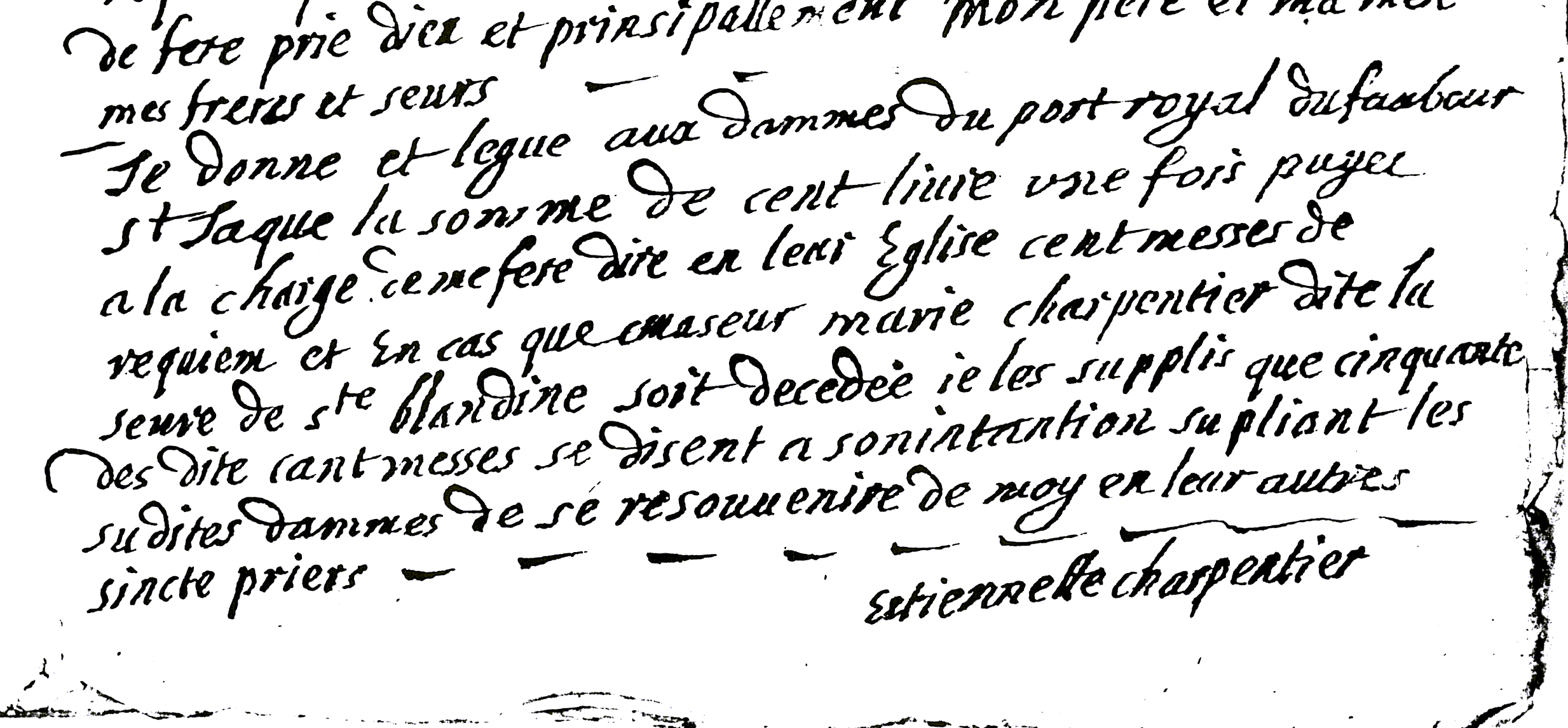
(For the entire will, consult: Etiennette's will, 1707)
Thanks to this new evidence that confirms my earlier conjectures, it is now possible to write about Marie Charpentier's life from the late 1650s until her death in the early eighteenth century.
First of all, Marie did not postulate to be a "choir" nun. In many abbeys to do so would have required a sizeable dowry, but Port-Royal had long prided itself on admitting poor girls to its choir (Constitutions, pp. 74-75). Money was therefore not the compelling factor in her or her parents' decision. Rather, it appears that Marie either could not sing and lacked other talents that might compensate for this "défaut" (p. 62), or else she felt called to spend the rest of her life as a domestic. Whatever the reasons, she committed herself to a life of service, glorying in the fact that God had given her the "talent" to serve. To be a converse, Marie had to be "solid" and healthy in body and mind, so we can assume that the Charpentiers were not ridding themselves of a crippled daughter who could neither marry nor conduct a business.
("Les sœurs converses seront choisies saines de corps & d'esprit doux & docile accompagné de solidité, afin que les occupations exterieures ne leur ostent point l'esprit interieur. ... On prend soigneusement garde si elles affectionnent leur codition, & que ce ne soit pas seulement l'incapacité d'estre de Chœur mais un veritable amour de la bassesse & de l'humiliation qui leur fassent embrasser cet estat, estant bien aises que la providence de Dieu en ait fait le choix pour elles en ne leur donnant pas les talens necessaires pour aspirer à autre chose. Que si mesme quelque fille qui seroit capable d'estre du Chœur demande d'estre Converse & que cela se puisse faire avec discretion, on luy accordera. ... Que les Sœurs converses se glorifient donc en leur hautesse comme dit S. Jacques, qui consiste en leur petitesse & en leur abaissement." Constitutions du monastère de Port Royal du S. Sacrement, by Agnès Arnauld (Mons, 1665), pp. 98ff: "Des Sœurs converses.")
Girls usually began their noviciate at sixteen or seventeen years of age, at which time they donned "une robe grise, une toque & un voile blanc, & un scapulaire qu'[elle mettra] seulement pour la Saint Communion, à la procession du S. Sacrement, et aux ceremonies où elles assistent, qui sont les cierges, les cendres, & les rameaux, et quand elles vont au parloir" (p.92). Marie almost surely received the habit of a novice a year later: "La ceremonie de la vesture se fera au Chapitre ou au bas du Chœur la Grille fermée. La Mere dira toutes les prieres qu'on dit aux Sœurs du Chœur, excepté la benediction de l'habit [et] du voile qui se sera faite par le Prestre avant la ceremonie." Her new habit consisted of "la robe et le scapulaire gris et le manteau blanc" (p. 92). At the end of her year-long noviciate, the choir nuns examined the converse and either voted to admit her or rejected her. If admitted, she immediately made her profession "entre les mains de l'Abbesse" and donned the habit of a converse professe: "le scapulaire gris avec la croix rouge & le voile noir" that had been blessed prior to the vote (p. 93). In other words, by the age of twenty, Marie de Sainte-Blandine was a full- fledges professe (p. 91).
As a converse, Marie Charpentier had "point de voix ny active ny passive" in how the abbey would be run. Indeed, she and the other converses were expected to "porter un grand respect aux Sœurs de Chœur, qui les traitteront charitablement & cordialement comme leurs Sœurs." Their basic needs were to be met, but since their childhood ("leur première nourriture") permitted them to get by on less than the nuns of higher station, they could not expect to live a more comfortable life than they would have in the world. The choir nuns were entitled give orders to the converses, who were supervised by the cellière (pp. 93-94) and who did the "plus grands travail, comme la cuisine, la boulangerie, la lescive, le soin des vaches & des poules, la cordonnerie & choses semblables" — but who under no circumstances could be asked to become the personal servant of one of the choir nuns or their nurse in the infirmary (p. 94). Nor could they be assigned to serve the children who boarded at the abbey, nor any benefactresses who came to the abbey (p. 95). Owing to the physical labor that the converses had to do each day, they were dispensed from most fasts, and could eat their regular fare on the day of a grande lessive, should this arduous task take place on a Friday (p. 98).
Although she was not entitled to sing, Marie listened worshipfully to the "psalmodie angélique" of the choir nuns, whispering the words as sincerely as the choir nuns sang them. Like the choir nuns she watched before the Holy Sacrement; and like them she went to bed at 8 in the evening, rising at 4 for morning prayers (p. 98).
When Marie Charpentier took her vows, there were 18 converses, 10 in Paris and 8 at Port- Royal-des-Champs. We can be more or less sure that she took those vows prior to April 1661, when all pensionnaires, all postulants and all novices were expelled (Sainte-Beuve, IV, p. 10). Was she one of the "two or three" weeping converses whom the Archbishop of Paris encountered in the cloister on August 27, 1664? Having just expelled some of the more recalcitrant choir nuns, "avec beaucoup de mépris" he said to these converses: "Taisez-vous, ne pleurez pas, vous n'en avez pas de sujet: on ne vous a ôté vos Mères que parce qu'elles étoient des désobéissantes & des rebelles. On vous en donnera d'autres à la place qui les voudront bien" (Vies édifiantes & intéressantes des Religieuses de Port Royal, 1751, III, p. 280).
Despite the fact that the converses technically had no say in the politics of the abbey, it is clear that they were adding their tears and their protests to those of the choir nuns. For, a year later (June 30, 1665), Mère Agnès addressed a letter to them sur le dessein que Mr l'Archevesque avoit, en envoyant ici une partie des Religieuses, de les laisser toutes à la maison de Paris avec l'autre partié de la communauté qu'il pretendoit gagner. "Mes trés chères sœurs," she began, "Je suis si touchée de la douleur que vous avez de la séparation qui se prépare, qu'il n'y a rien que je ne volusse faire pour vous adoucir cette amertume." It is a "tems de sacrifice," she continued, urging the converses to remain calm and do what God leads them to do, remembering that she will always be close to them.
Marie Charpentier spent the so-called "Peace of the Church" (1668-1679) in the Parisian house on the rue Saint-Jacques. That is where the will dictated by her sister Étiennette places her in January 1676; and that is where Marie de Sainte-Blandine remained during the tenure of Marguerite de Harlay, 1685-1695, and until her own death. One hopes that — if she helped prepare the "magnificent" collation the followed the mass composed by her brother Marc-Antoine for the Cordeliers of the Great Convent, in honor of the Harlays, brother and sister, and performed at Port Royal of Paris on July 20, 1687 — she was also able to attend that service:
"Pour en rendre la solemnité plus éclatante, Madame l'Abbesse de Port Royal, digne Sœur de cet illustre Prélat [François de Harlay, Archibishop of Paris], de vouloir bien qu'on la fist dans son Eglise...., jour de Ste Marguerite, dont elle porte le nom. Le Père Gardien avec ses Officiers, et accompagné d'environ trente Religieux, se rendit dans l'Eglise de Port Royal le matin de cette Feste. On commença par chanter Tierce, et ensuite la grand'Messe fut chanté avec toutes les cérémonies du Grand Couvent, et plusieurs Motets de Musique au Saint Sacrement, à Sainte Marguerite et pour le roy, après quoy l'on chanta Sexte. Au sortie de l'Eglise, ils furent traitez magnifiquement avec les Directeurs et les Aumoniers. On chanta Nones et Vespres à l'heure ordinaire, en plein-chant et en faux-Bourdon, et cela fait, le Père le Blanc, Vicaire du Grand Couvent, prononça le panegyrique de la Sainte avec beaucoup de succes. Il dit de Madame l'Abbesse de Port Royal qu'elle conduisoit sans commander, qu'elle gouvernoit sans regner, et qu'elle estoit dans son sex ce que Mr de Paris est dans le sien. Un salut en musique termina la Feste. Il fut chanté par les mesmes Pères, qui firent tout l'Office de ce jour-là d'une manière qui fit conoistre le zèle qu'ils ont pour Mr l'Archevesque et pour Madame l'Abbesse de Port Royal" (Mercure galant, August 1687, pp. 96-97)
The music of the mass, sung by three women, survives in Marc-Antoine Charpentier's autograph notebooks (H. 5). In 1988 it was recorded by the Capella Ricercar (RIC 052034, which retains the pieces for Sainte Marguerite but omitted the portion dedicated to Saint François). A still grander — but not yet identified — musical event took place at Port-Royal early in the 1690s, when two male singers joined two nuns and a certain "Mlle du Fresnoy" in a Dixit Dominus (H. 226), a Laudate Dominum omnes gentes (H. 227) and a Magnificat (H. 81), on the same Ricercar CD.
It is impossible to say whether, at the time of Marie's noviciate, the Charpentier family shared the Jansenist position of the Arnaulds. We do know, however, that by 1676 Étiennette was very close to the Jesuits of the different Parisian houses. That Port Royal had left behind its austerity by the late 1680s therefore probably did not disturb Étiennette unduly. Nor is it likely that Marc-Antoine was a secret Jansenist: he composed for the Jesuits regularly from the early 1670s on, and he became their chapel master circa 1688. As for Marie, if any Jansenist coals glowed in her heart, for the rest of her long life she doubtlessly struggled to extinguish them. Day after day, as she heeded the orders of a succession of anti-Jansenist abbesses, was she guided by the memory of Mère Agnès's admonition? Did she always seek to do what God leads her to do, remembering all the while that Mère Agnès would will always be close?